The limits of logs and alerts: why SOC judgment stops at inference
In 2025, organizations worldwide faced an average of 1,968 cyberattacks per organization per week, 70% more than in 2023 (Check Point Cyber Security Report 2026). Estimates put the shortage of security professionals at 4.8 million (2024 ISC2 Cybersecurity Workforce Study). Attacks are getting faster and more numerous, and the people available to handle them are not growing at the same rate. Operations that depend on predefined rules and manual alert triage struggle to respond within the critical window. This is why SOC automation built on AI agents is now on the table as an alternative.
Automation by itself is not the answer. Most SOC judgment today rests on state information: logs, alerts, and events. A judgment that takes in only logs and alerts stops at inference, whether an analyst makes it or an AI does. Logs and alerts show the state of an occurrence and nothing more. They do not show what was actually exchanged, how far it departed from normal, or why the verdict came out as it did. Context data fills those three gaps, each layer supplying grounds in its own role, and the grounds for automating judgment become more complete when all three are fed in together. Raise the speed without the grounds, and what gets faster is inference, not judgment.
How agentic AI differs from simple automation
Agentic AI is autonomous AI: given a goal, it plans and executes on its own. It decides the next action from its reading of the situation at hand, not from a predefined rule. A security orchestration, automation, and response (SOAR) playbook runs only when the conditions defined in advance hold. Faced with an attack pattern it has never seen or a combination of conditions that differs from the script, the response flow stops at that condition. Agentic AI infers the context at that point and carries the judgment forward.
Autonomy comes with a condition. In playbook automation, a condition defined by a person stood in for judgment. Agentic AI makes that judgment itself, which is why the quality of the input data becomes the quality of the result. Given data that captures only symptoms, such as an alert summary, the AI’s reasoning stays within the bounds of that summary. Given the raw traffic and sessions as well, it rules on the activity that actually took place. The structure may be the same, but the reliability of the judgment follows the input.
The five stages of security operations and where automation applies
SOC operations consist of five stages: collection, detection, alert triage, in-depth investigation, and response. The role of the AI agent differs at each stage.
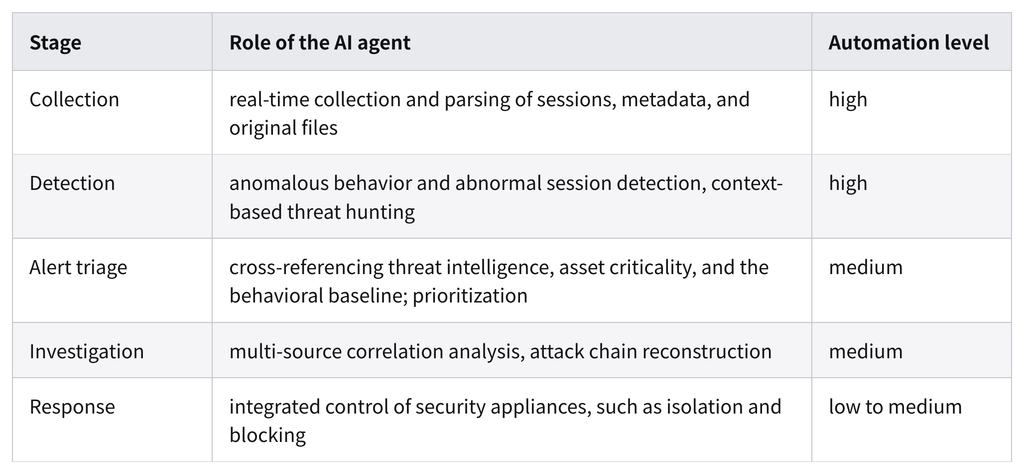
Collection and detection are where automation pays off most. In alert triage, the AI cross-references threat intelligence, asset criticality, and the behavioral baseline to narrow in advance what an analyst needs to review. How much investigation time the automation saves depends on the input data and the operating environment, so this article does not present a single figure. Isolation and blocking are different in kind. A single false positive directly affects business continuity, so in current operating environments the realistic model is semi-autonomous: the AI proposes the action, and a person approves its execution.
What makes judgment quality differ within the same agentic structure
Different input means a different risk for operations to carry. An AI that receives only alert summaries can describe the symptoms but rarely pins down the cause. In that structure, false positives grow, and so does the likelihood of AI hallucination. The higher the level of autonomous execution, the heavier that burden, because a wrong inference flows straight into the next action without human review.
The AI needs three kinds of context data to draw on: raw transaction/session data, which holds what was actually exchanged; behavioral baseline data, which shows the direction and size of the deviation from normal; and Explainability (XAI) data, which records the path that led to the verdict. Each supplies grounds for alert triage in its own role, and when all three are fed in together, cross-referencing lightens the false-positive burden further. If one is missing, the verdict is less reliable by exactly the grounds that layer would have supplied. The principle that the completeness of the input sets the ceiling on judgment quality holds in an agentic structure just as it does elsewhere.
Evaluation criteria for adoption: level of autonomy and governance
The items usually examined when evaluating an AI SOC agent are depth of investigation, level of autonomous control, feedback loop, deployment model, and pricing structure. One error recurs in these reviews: treating MITRE ATT&CK coverage figures or alert counts as the headline measure of detection capability. Coverage shows only how far the detection rules extend. Whether the agent detects, from context, an attack that bypasses those rules or anomalous insider activity carried out on a legitimate account is a separate question. For agentic automation, the organization must confirm three more things together.
- Stage-by-stage control of autonomous execution: the scope must be controllable per scenario, from proposal only, to execution after approval, to full autonomy.
- False-positive feedback into the next judgment: if the analyst’s verdicts do not flow back into learning, the same false positives recur.
- A means for people to verify AI judgment: an agent that cannot present the grounds for its judgment becomes harder to supervise as its autonomy grows, so the means of verification comes first.
Governance is the name that brings the three criteria together. Without an internal verification framework that blocks AI hallucination and malicious command injection such as prompt injection, every widening of autonomous execution turns wrong judgments into actions just as directly.
The analyst’s role: from executor to supervisor
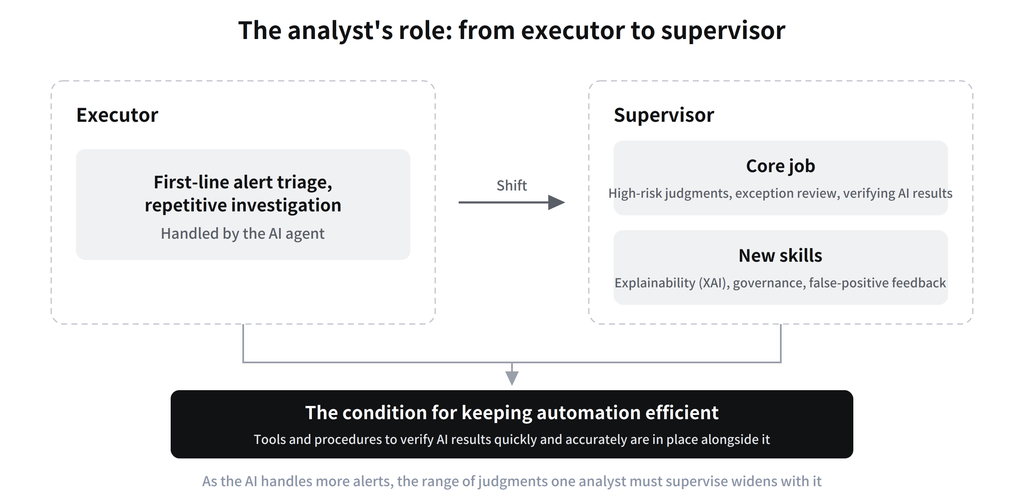
Once the AI agent takes over first-line alert triage and repetitive investigation, the analyst’s role shifts from executor to supervisor. High-risk judgments, exception review, and verifying AI results become the core job, and interpreting Explainability (XAI), running governance, and managing false-positive feedback join the job as new skills. One point deserves attention: as the AI handles more alerts, the range of judgments one analyst must supervise widens with it. Automation stays efficient only when tools and procedures to verify AI results quickly and accurately are in place alongside it.
Regulatory environment: what Korea, Japan, the United States, and the EU all require
In heavily regulated environments there is one more thing to confirm. The names of the regulations differ by jurisdiction, but what they demand is the same: report incidents within a fixed deadline, retain the records behind a judgment for a fixed period, and produce them for audit and investigation.
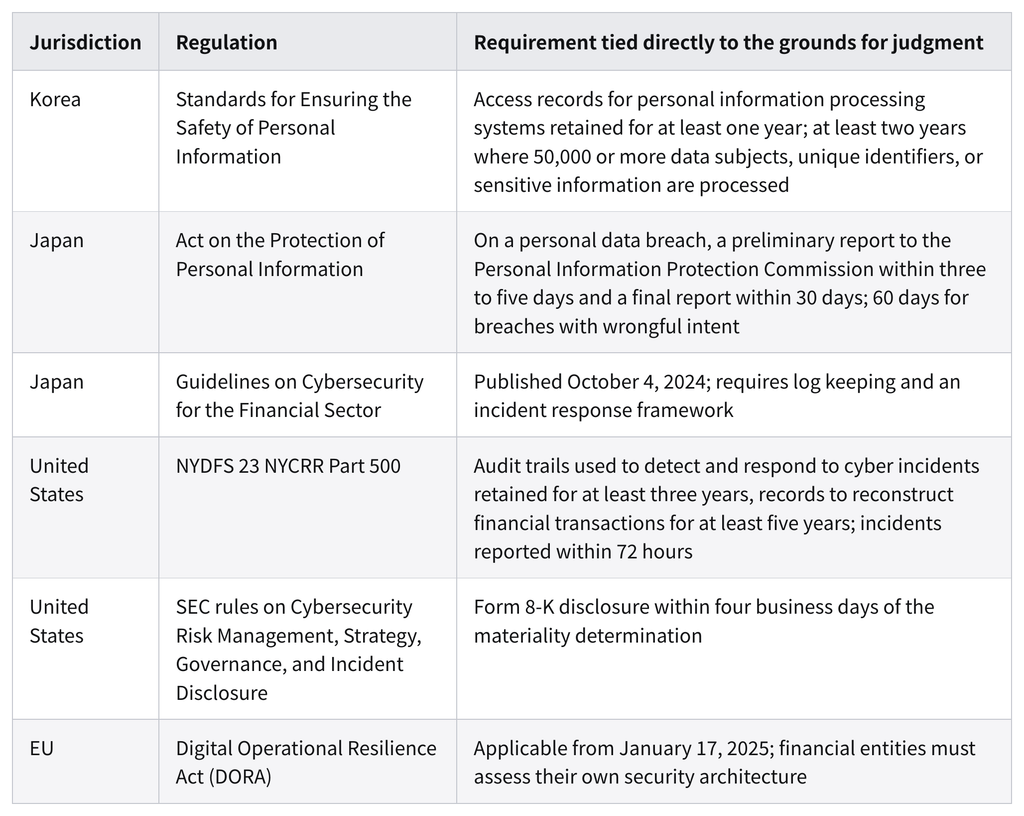
Retention periods and reporting deadlines vary by jurisdiction, but the premise is the same: the records to submit to an investigation must still exist. Once an AI makes the judgment, one more condition applies. The grounds on which the AI judged something a threat must be submittable, as they are, to a regulatory audit or a breach investigation. A verdict that cannot be reproduced at the level of the raw traffic is hard to use as technical grounds. The reporting deadline may be three to five days under Japan’s Act on the Protection of Personal Information, 72 hours under NYDFS 23 NYCRR Part 500 in the United States, or four business days under the SEC cybersecurity incident disclosure rules. Whichever it is, meeting it means nothing if the evidence cannot be assembled and explained within that window. In regulated environments, whether the organization can secure forensic data at the packet capture (PCAP) level therefore becomes the key criterion for choosing a solution.
From automated inference to automated judgment
Automated attack generation and execution have reached a pace that detection, investigation, and response carried out by people cannot match. An organization considering SOC automation built on AI agents has three things to confirm.
- Staged application: automate collection, detection, and alert triage first, and start response in a semi-autonomous structure in which the AI proposes and a person approves execution.
- Supervisory structure: put autonomy control, a feedback loop, a means of verifying judgment, and governance in place before adoption.
- Input data: confirm that Raw Transaction/Session, Behavioral Baseline, and Explainability (XAI) data are fed into the AI as input.
The structure may be the same, but the result is decided by the input. Alert summaries as input automate inference; three-layer context data as input automates judgment. Taking SOC automation one step further means widening the context data the AI can draw on before widening the scope of what it executes. Closed-loop automation that runs from detection through analysis and judgment to response, or autonomous security operations, works on the grounds secured this way. When evaluating SOC automation, then, the first question is not which AI to choose but what that AI will receive as input.
Frequently asked questions
Q. How does SOC automation built on AI agents differ from conventional SOAR?
SOAR runs only on predefined playbook conditions; an AI agent infers context and responds even to new attack patterns that no condition describes. What changes in practice comes next: the scope of autonomous execution must be controlled stage by stage, together with a supervisory structure that verifies the judgment.
Q. Does adopting an AI SOC agent make security analysts unnecessary?
Automation takes over repetitive alert triage and first-line investigation. High-risk judgments, exception review, and verification of AI results remain with people. The analyst’s role shifts from executor to supervisor; it does not disappear.
Q. What should financial institutions and public-sector organizations check in particular when adopting AI SOC automation?
The key criterion is whether the original data behind an AI verdict, forensic data at the PCAP level, can be secured. For an organization in Korea, the access record retention requirement under the Standards for Measures to Ensure Safety of Personal Information applies first. One with overseas business must also check the breach reporting deadlines under Japan’s Act on the Protection of Personal Information, the audit trail requirements under NYDFS 23 NYCRR Part 500 in the United States, and DORA in the EU. Either way, internal network visibility and forensic response capability should be checked against the same standard.