What security AI hallucination is and how it turns into misjudgment
It is now well known that a chatbot can generate a paper that never existed and present it as fact. The same thing happens in security AI. When the AI must judge from data that only summarizes what happened, it delivers a conclusion that does not match the facts, and delivers it with confidence. The mechanism is the same; the consequences are not. In the general domain, a hallucination ends as a wrong answer. In security, it becomes a false positive that rules normal communication a threat, or a misjudgment that lets a real threat pass as normal. Either one leads straight to a failed response.
The cause is a gap in the grounds for judgment. Logs and alerts record that something happened. They do not record why it happened or what the communication actually contained. The AI fills that gap with inference. The more plausible the inference, the more dangerous it is, because the output alone does not distinguish it from a judgment backed by grounds.
The operating cost of hallucination: a vicious cycle and two extremes
The cost of hallucination does not end with one wrong judgment. As false positives accumulate, analysts must check each incoming alert by hand. The heavier that verification burden grows, the less attention the alert stream as a whole receives, and real threats pass unnoticed in the meantime. False positives breed false positives.
When the grounds for a judgment cannot be confirmed, operator behavior splits into two extremes. Operators either accept the AI alert as it is and execute a wrong block or isolation, or decide the AI cannot be trusted and ignore the alerts wholesale. Either way, the point of adopting AI disappears. The first is a structure that executes misjudgments automatically; the second is a structure that spends money generating alerts and nothing else.
In regulated industries, this cost spreads beyond operations into the institutional domain. In finance, healthcare, and the public sector, an AI judgment that cannot present its grounds can lead to failed audit responses and legal liability. An action or a report based on a misjudgment becomes a liability issue in itself.
What regulators require is the same across jurisdictions. In Korea, the Standards for Measures to Ensure Safety of Personal Information require organizations to retain the access records of personal information processing systems for at least one year. The period rises to at least two years if the organization processes 50,000 or more data subjects, unique identifiers, or sensitive information. Under Japan’s Act on the Protection of Personal Information, an organization that suffers a personal data breach must submit a preliminary report to the Personal Information Protection Commission within three to five days. A final report follows within 30 days. In the United States, NYDFS 23 NYCRR Part 500 requires firms to retain the audit trails they use to detect and respond to incidents for at least three years. In the EU, the Digital Operational Resilience Act (DORA), applicable since January 17, 2025, requires financial entities to assess for themselves whether their security architecture meets the regulatory requirements. This is why the ability to present the grounds for a judgment, and not its accuracy alone, has become an adoption requirement.
RAG for security AI: input design that reduces hallucination by structure
In general-purpose AI, the representative method for reducing hallucination is retrieval-augmented generation (RAG). Rather than letting the model answer from its trained memory alone, RAG has it retrieve and consult external material at the moment of answering. The approach differs in that hallucination is reduced by designing the reference structure, not by swapping the model.
In security AI, the counterpart of that reference structure is context data. Instead of letting the AI judge from an alert summary alone, the structure has it confirm the actual communication content in raw transaction/session data at the moment of judgment. It then has the AI consult the behavioral baseline for how far the activity departs from the norm. When Explainability (XAI) records how the judgment was reached, operators can check its grounds the way they check the source documents behind a general-purpose AI answer.
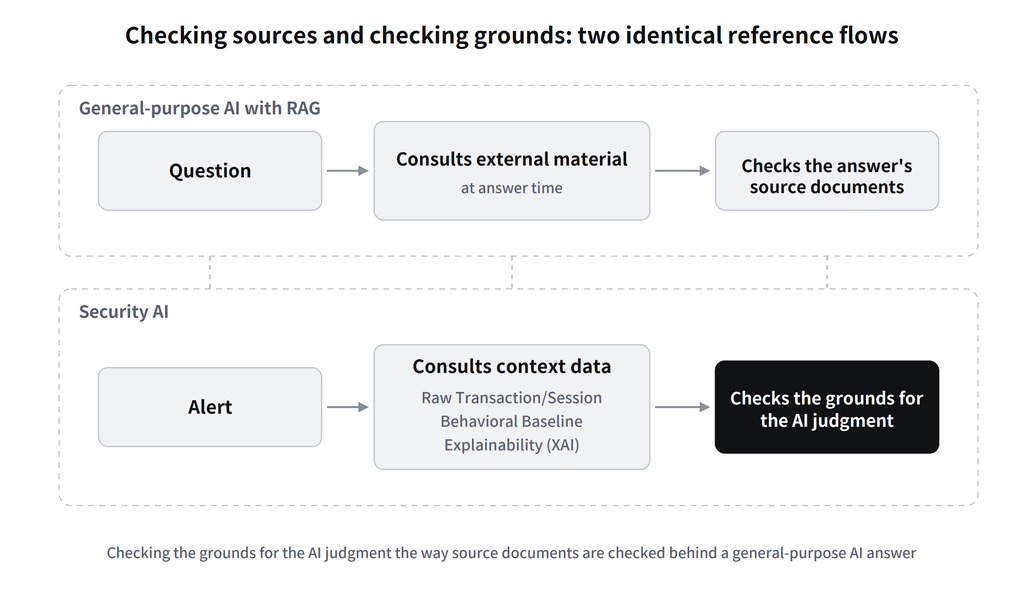
Preserving the three-layer context data is not enough on its own. Raw Transaction/Session, Behavioral Baseline, and Explainability (XAI) must be data the AI can call up at the moment it judges. Even a structure that satisfies the retention requirements falls short if the raw data is out of reach at the moment of judgment. The AI then goes back to judging from summaries alone.
Combining the layers: how false positives are told apart
The effect of the reference structure appears in each layer and grows when the layers combine. When the behavioral baseline detects a session that differs from the norm, the system reconstructs that session’s raw data from the full packets and confirms its actual content. With that combination, confirmation rather than inference settles whether the deviating session is a real threat or a passing change in a normal business pattern.
When the session is confirmed as a real threat, the same combination serves again at the investigation stage. With the raw data preserved, investigators reconstruct the entry path, the execution sequence, the external communication, and any exfiltration as a single incident flow. Investigation stops being a circular check between logs and becomes confirmation based on the raw data. Because the decision process remains in Explainability (XAI), the same grounds serve for post-incident verification and audit response.
Environmental conditions: closed networks and the cloud
The design of the reference structure changes with where the data lives. In a closed network, a structure in which the raw data is never sent outside works to the organization’s advantage. When the AI judges only from raw data preserved inside, the risk of contamination from external dependencies and the risk of a sensitive-data leak both fall. Hallucination control and data protection are achieved in the same structure.
In the cloud, the opposite holds: securing the raw data is itself the item under review. Traffic mirroring in a virtual network is limited by each service’s supported scope and processing capacity. The first thing to confirm is therefore whether full collection at the same level as on-premises is possible at all. If the mirroring segment loses traffic, that segment becomes an area the AI cannot consult, and judgment in an area it cannot consult falls back on inference.
Questions that test for hallucination in a PoC
At the adoption review stage, a proof of concept (PoC) demonstration, not a feature list, confirms the likelihood of hallucination. Asking for the following three things reveals the reference structure.
- Can the grounds for a given alert be presented?: pick one alert that has fired and ask the AI to present, on the spot, the features and data it based its judgment on. If it cannot present the grounds, the two-extremes behavior recurs in operation.
- Can the raw data of a deviating session be reconstructed?: ask for a demonstration in which a session detected by the behavioral baseline is reconstructed at the raw level and the false-positive question is settled. If it cannot be reconstructed, telling false positives apart remains a matter of manual inference.
- Where are the areas the AI cannot consult?: ask the vendor to specify the segments the AI cannot consult because of the collection method and environmental constraints. A gap that is not specified gets filled with inference during operation.
What the three questions have in common is that none of them asks about model performance. Hallucination falls not when the model is swapped but when the data the AI consults at the moment of judgment changes. The focus of an adoption review must therefore be the completeness of the reference structure. Once that completeness is secured, autonomous security operations, running from detection through analysis and judgment to response, also run on grounds that can be trusted.
Frequently asked questions
Q. How does security AI hallucination differ from general AI hallucination?
The mechanism is the same. Judging without grounds to consult produces a plausible wrong answer. The consequences differ. In security, that wrong answer leads to a real response such as a wrong block or a threat left unattended, and in a regulated environment it spreads into audit and liability issues.
Q. Is security AI without Explainability (XAI) a problem in practice?
When the grounds for a judgment cannot be confirmed, operators split into two extremes: accepting alerts as they are or ignoring them wholesale. In both cases, false positives accumulate and response quality declines. Only when operators can check the decision process do they accept or reject alerts on grounds.
Q. How is the likelihood of hallucination verified before adoption?
The most practical way is to ask for three live demonstrations at the PoC stage: the grounds for an alert judgment, the reconstruction of a deviating session’s raw data, and the segments the AI cannot consult. A feature list or a coverage figure alone does not show the reference structure at the moment of judgment.