Uncollected segments and the limits on investigation scope
A breach investigation starts by examining what was communicated at the moment the alert fired. If the packets for that window were never stored, the investigation ends where the logs and alerts end, and the transferred file and its path remain unknown.
In a high-volume traffic environment, this happens even after full-packet storage is in place. No analysis engine downstream can recover a packet lost during collection or storage, so for the window where the loss occurred, the original data simply does not exist. Three-layer context data, made up of Raw Transaction/Session, Behavioral Baseline, and Explainability (XAI) data, likewise comes from stored packets. Collection and storage design sets the scope of the input available for judgment.
The three points where packets are lost
Packet loss occurs at three points: collection, storage, and data integration. What is lost, and whether it can be recovered, differs at each point. [Table 1] sets out the distinction.
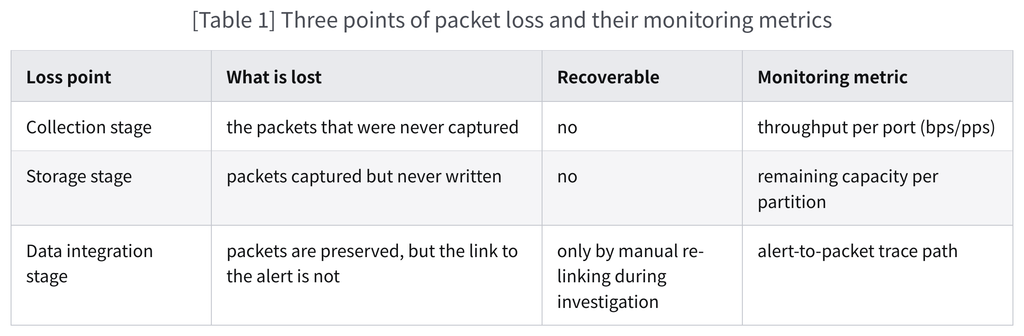
Loss at the first two points leaves no data behind, so nothing can recover it after the fact, and only design can prevent it. Loss at the third point is different: the data still exists, but the link between the alert and the raw packets does not hold, and manual investigation can restore it. The first two points are a matter of data preservation; the third is a matter of investigation cost.
Point one, collection: capture method and sensor count
The first point, collection, starts with the choice of capture method. Packet capture copies and records the packets that pass through the network. The method chosen determines whether loss occurs, what it does to operations, and whether it suits long-term use. [Table 2] compares the options.
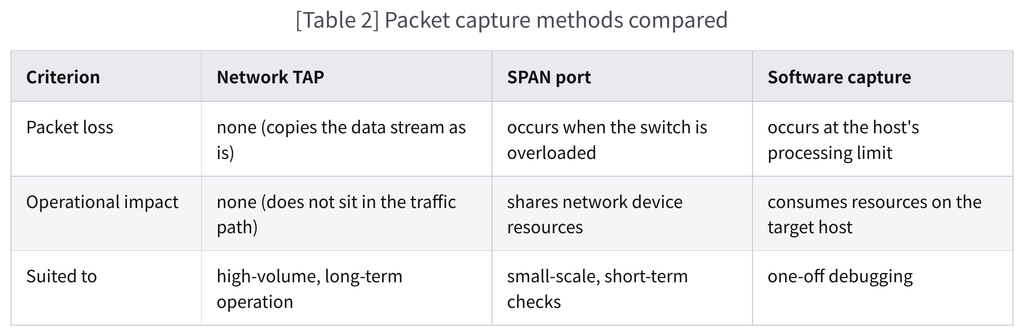
On high-volume segments, the SPAN port method, which shares the network device’s resources, is the first of the three to reach its limit. When peak traffic pushes the switch past its processing capacity, loss begins, and nothing recovers the packets from that window. Segments meant for long-term operation use a method that copies the data stream as is, without sitting in the traffic path.
The next decision is the number of sensors. On a segment that exceeds the bandwidth a single sensor can process, several sensors must share the traffic, and the way they share it depends on the type of segment. [Figure 1] shows how Network Blackbox arranges its collection paths.
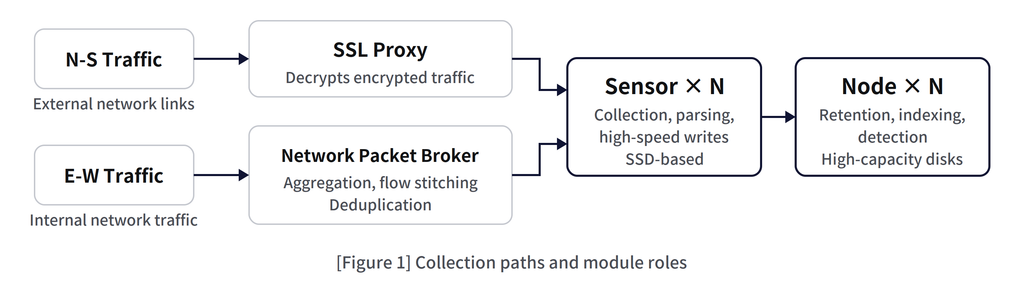
The upper path in [Figure 1] is north-south traffic, the traffic that connects to external networks. A copy taken by port mirroring or a test access point (TAP) is still encrypted, so storing it reveals nothing about its contents. For encrypted communication, the sensor therefore collects traffic after an SSL proxy has decrypted the SSL/TLS session.
The lower path, internal communication or east-west traffic, is high in volume and spread across many routes. Duplicate copies of the same packet appear, and the two directions of a flow travel different routes, so a network packet broker (NPB) first aggregates the mirrored traffic. The broker then performs flow stitching, which reassembles the split directions into one flow, and deduplication, which removes the copies created along the way. Both operations work only where all of the traffic comes together, so they run before the traffic reaches the sensors.
Session-based load balancing then spreads the groomed traffic across multiple sensors. A sensor reassembles packets in order to restore files and content. If one session’s packets land on different sensors, no sensor holds the whole session, and application-layer (L7) reassembly fails even when the load is evenly balanced. On both paths the sensor is passive: it only receives copied traffic, so a sensor failure has no effect on production traffic.
Once the design is in place, the next step is to verify actual loss rather than assume it. Every monitoring port in the link-up state periodically reports its bandwidth (bps) and packet rate (pps) over Syslog in Common Event Format (CEF). The operations console therefore shows the capture rate during peak periods directly, with no need to estimate it from averages.
Point two, storage: write speed and retention period
The second point, storage, starts with write speed. Even with loss eliminated at collection, the storage layer drops packets when it cannot write as fast as the sensors capture, and adding disk capacity does nothing to reduce that loss. Storage design therefore checks write speed before capacity.
A configuration in which no single medium plays both roles closes the gap between capture speed and write speed. The right side of [Figure 1] shows this split. Sensors run on SSDs to handle the high-speed writes that follow capture, and nodes run on high-capacity disks to handle full-packet retention and indexing. The result is a tiered structure: sensors for high-speed collection, nodes for long-term retention.
The next decision is capacity. Total capacity is the average daily capture volume multiplied by the required retention period. The same hardware retains data for different lengths of time depending on traffic characteristics, so the baseline figure must come from traffic measured in the actual environment. Syslog reports utilization and remaining capacity per partition in the same way, so any gap between the estimate and actual usage shows up during operation.
The last decision is the retention period. Investigation requirements set it, not available capacity: the design works backward from what an investigation must be able to reach. The window under investigation precedes the moment a breach comes to light, so a short retention period means the system has already overwritten the window that is needed. Reassembling stored packets and running Rebuild, the retrospective re-analysis capability of Network Blackbox, both return results only from data within the retention period. Storage design sets how far back retrospective re-analysis can reach.
Point three, data integration: a single, unbroken pipeline
The third point, data integration, determines whether preserved data can be used in an investigation at all. When collection and analysis run on separate systems, transferring data between them introduces delay. The link between the original data and the detection result breaks, and the investigation from an alert back to the raw packets becomes manual work once again.
The configuration that removes this break is a single pipeline that keeps logs and full packets in one data store. [Figure 2] shows the pipeline as QUADX structures it.
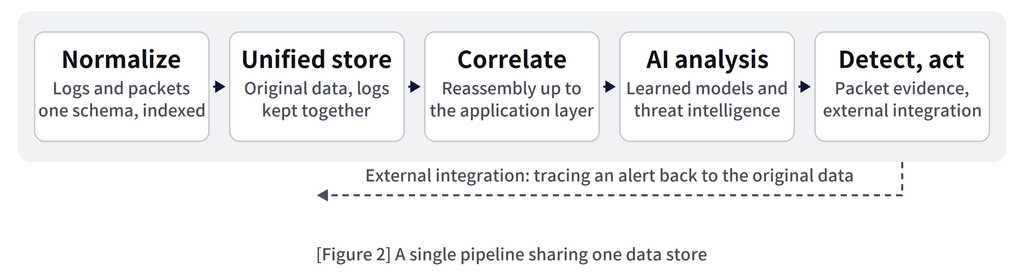
The five stages in [Figure 2] are normalization and indexing, unified storage, correlation analysis, AI analysis, and detection and response. The correlation stage produces the grounds for an investigation: it reassembles logs and packets up to the application layer and analyzes the threat context through rules, scenarios, and relationships. The full packets preserved at the first two points are the input to this stage.
Running a query from an external system shows the integration at work. As the dashed path at the bottom of [Figure 2] shows, an external system searches the metadata through the integration interface and, with the same query, retrieves the raw packets of the session.
Event forwarding covers five kinds of events beyond detection events. The system sends detection events, sessions, metadata, attachments, system status, and audit logs in the same CEF format. In this structure, the receiving security information and event management (SIEM) or security orchestration, automation, and response (SOAR) system gets, along with each alert, the key that traces that alert back to the original data. Preserving evidence intact at the packet capture (PCAP) level at the response stage also depends on this integration.
Deployment structure: choosing between AIO and Expand
The configuration that covers all three points (collection, storage, and data integration) depends on traffic volume. The three software modules, sensor, node, and manager, are the same in every case; what differs is the hardware deployment, which gives the two structures in [Table 3].
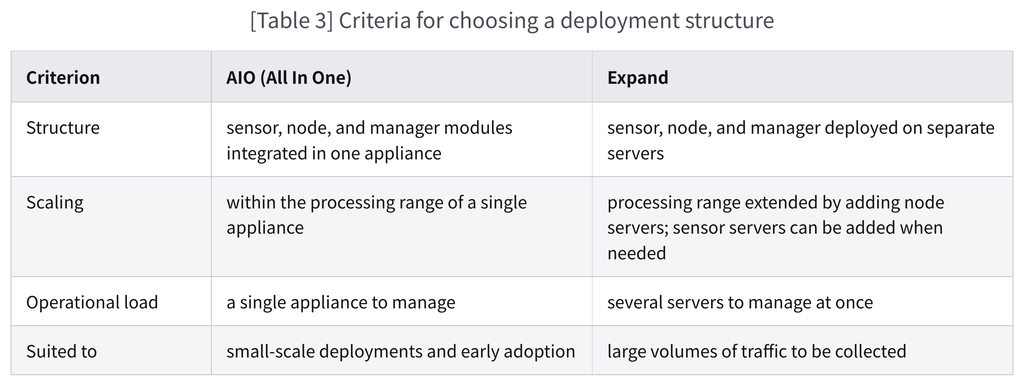
What separates the two structures is the volume of traffic to be collected. When that volume exceeds what a single appliance can absorb, the answer is to add node servers rather than upgrade the appliance. On segments where capture bandwidth exceeds what one sensor can process, the deployment adds sensor servers as well. The inputs to that choice are the average daily traffic volume adjusted for peaks, the retention period worked backward from investigation requirements, the segments to be captured, and the operations staff available. Measured traffic during the evaluation stage sizes the processing range for each environment.
Throughput design and the input to autonomous security operations
The three points and the deployment structure above are design items whose purpose is to secure the input for autonomous judgment. As attack execution becomes more automated, an operating model in which analysts check alerts one by one cannot keep pace. What becomes necessary is closed-loop automation that runs from detection through analysis and judgment to response, or autonomous security operations.
Autonomous judgment is never settled without grounds. Raw transaction/session data pins down what was actually communicated, the behavioral baseline expresses anomaly as a number relative to normal, and Explainability (XAI) verifies the decision process. A packet lost at collection or storage, however, leaves no trace in the raw transaction/session data, in behavioral baseline learning, or in the grounds for explainability. If data integration is broken, the three layers that were generated never reach the alert, and the investigation cannot use them. The first two points limit the generation of the three layers; the third limits their use.
The product configuration follows the same three points. Network Blackbox generates the three layers at the collection and storage stages, and QUADxAI (roadmap) connects logs and original data into one investigation flow at the data integration stage. The three layers secured this way become the grounds for AI analysis and verdicts. In autonomous security operations, the advantage comes not from the speed of response but from the completeness of the input.
Frequently asked questions
Q. Is packet loss unavoidable when storing full packets in a high-volume environment?
Loss is confined to three conditions: a capture method that shares network device resources, a segment without a distributed design, and write speed that falls short of capture speed. The countermeasures are, in the same order, a capture method that stays out of the traffic path, session-based load balancing, and separating high-speed writes from long-term retention.
Q. Is storing metadata alone enough for threat detection?
Metadata alone shows communication patterns, so it works for real-time anomaly detection. Flow summaries (NetFlow, IPFIX, and similar), however, record only who communicated with whom, not what was transferred, which limits the scope of root cause analysis and retrospective re-analysis after an incident. The depth of investigation required should decide whether full-packet storage sits alongside metadata.